Unlock Version
Lock Version
Changelog for QGIS 3.8

Release date: 21 June, 2019
QGIS 3.8 brings an extensive list of new changes and a lot of polishing of existing features - the highlights of which we will try to cover here. As always can we remind you that QGIS is an open source project and if you are able to, consider supporting our work through donations, sponsorship or contributions to the code documentation, web site and so on.
Thanks
We would like to thank the developers, documenters, testers and all the many folks out there who volunteer their time and effort (or fund people to do so). From the QGIS community we hope you enjoy this release! If you wish to donate time, money or otherwise get involved in making QGIS more awesome, please wander along to qgis.org and lend a hand!
QGIS is supported by donors and sponsors. A current list of donors who have made financial contributions large and small to the project can be seen on our donors list. If you would like to become an official project sponsor, please visit our sponsorship page for details. Sponsoring QGIS helps us to fund our six monthly developer meetings, maintain project infrastructure and fund bug fixing efforts. A complete list of current sponsors is provided below - our very great thank you to all of our sponsors!
QGIS is Free software and you are under no obligation to pay anything to use it - in fact we want to encourage people far and wide to use it regardless of what your financial or social status is - we believe empowering people with spatial decision making tools will result in a better society for all of humanity.
Expressions
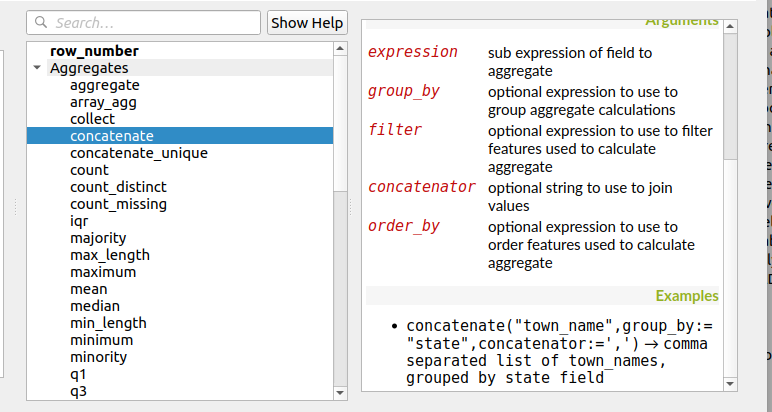
Since certain aggregate and concatenation expressions require results in a certain order, we now allow control over the order features are added to the aggregate during expression evaluation.
E.g. concatenate("Station",concatenator:=',', order_by:="Station") will give a comma-separated list of station names in alphabetical order, rather than layer feature order.
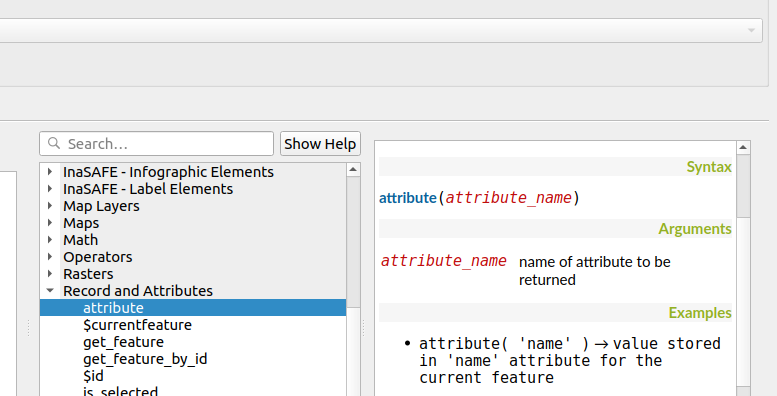
This improvement brings a second variant for the existing "attribute" function. The "attribute" function in previous QGIS releases required both a target feature and attribute name to be specified. The new version is much simpler, automatically using the current feature and only requiring an attribute name.
E.g.
Previous behavior:
attribute($currentfeature, 'name' ) -> returns value stored in 'name' attribute for the current feature
Improved behavior:
attribute( 'name' ) -> returns the value stored in 'name' attribute for the current feature
It's just a faster shorthand version!
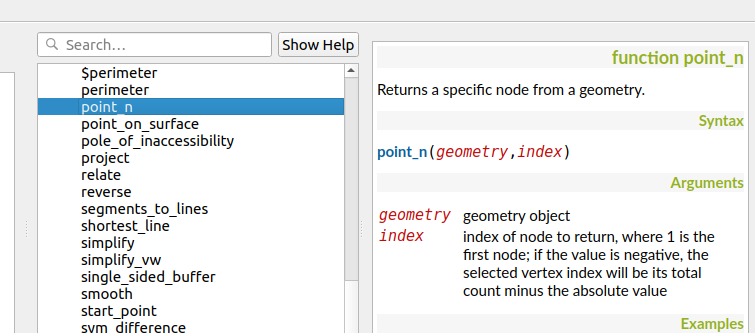
We added negative index support to the point_n(), angle_at_vertex(), and distance_to_vertex() functions, allowing for retrieval of vertices counting backward from the end of a geometry.
This feature was developed by Mathieu Pellerin
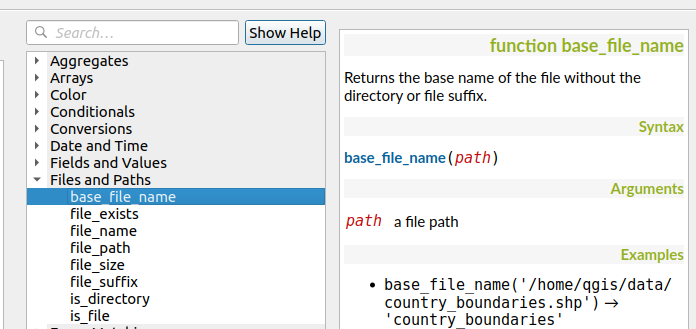
As always, a new QGIS release brings a bunch of new functions for use within QGIS' expression engine. These new functions add increased flexibility and power to the expression engine, and everywhere it's used throughout QGIS. This round, we've added a set of new functions which make it super-easy to operate on file names and paths.
New expression functions developed by Nyall Dawson of North Road:
- base_file_name: Returns the base name of the file without the directory or file suffix.
- file_exists: Returns true if a file exists
- file_name: Returns the file name from a full path
- file_path: Returns the directory/path from a full file path
- file_size: Returns a file size
- file_suffix: Returns a files suffix/extension
- is_directory: Returns true if a file path is a directory
- is_file: Returns true if a file path is a file
New expressions functions developed by Mathieu Pellerin of iMHere Asia:
- array_all: Returns true if an array contains the all values of a given array.
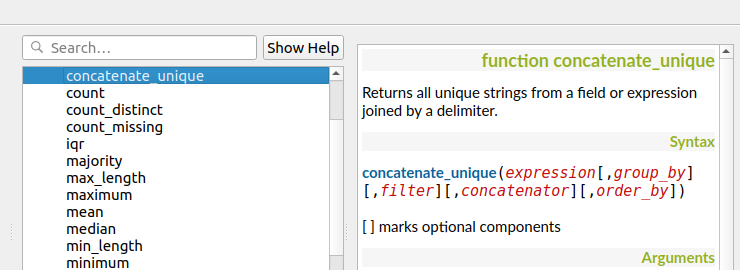
- concatenate_unique: Returns all unique strings from a field or expression joined by a delimiter.
We added a new function concatenate_unique() to the expression engine (and Processing's "aggregate" algorithm) to support concatenating only unique values from a list or set of features.
This feature was developed by Mathieu Pellerin
Import PR from Github into Entries